Client: Relocation and integration start-up, Portugal (anonymised)
Agency: Cocoon Experience, Lisbon
When: August to October 2021
My role: UX Researcher
Team: Project manager, UX and service designer, UX researcher, UX/UI designer
Methods: Kickoff workshop, 20 remote interviews, projective exercises, affinity mapping, personas and as-is journeys, co-creation workshop, feature prioritisation, 10 moderated usability tests

Where do I begin?
In 2021, a relocation start-up in Lisbon had a service, a network of lawyers, realtors and tax advisers, and a clear picture of the product it wanted: one platform to inform people, match them with the right providers and manage their move. What it didn't have was evidence. I led the research that tested that picture against the people it was for.
Context and brief
The company helped people move to or invest in Portugal: visas, tax, housing, schools, bank accounts. It worked through calls and email. There was no product yet, only early prototypes. The founders brought in Cocoon Experience to validate their concept and define an MVP.
The brief came down to five questions:
1. What do people moving to Portugal value most, and why Portugal?
2. How do they research the move?
3. Why do they use a relocation company, and how do they choose one?
4. Where does the process break down, before, during and after the move?
5. What would make it feel smooth and reliable?
My role
I was the UX researcher in a four-person agency team. I led the research end to end: the interview script, recruitment, 20 remote interviews, the projective exercises, and synthesis through affinity mapping into an insights board. From the interviews I built the segmentation, four personas and their as-is journeys, and co-facilitated the co-creation workshop and the feature prioritisation sessions with the client team.
The problem reframed
The founders' concept rested on three assumptions: people are drowning in information, there are too many providers to choose from, and there is too much to manage. Their answer was an all-in-one platform.
The interviews confirmed the overload but not the cure. People knew how to search. What they couldn't do was tell what applied to them, what to trust, or what to do first. And they didn't expect a platform to answer that. They trusted a person. Most clients arrived by referral, and the first call, not the website, was where they decided.
So the MVP's job changed. Not to replace the human, but to get people from "where do I begin?" to that first conversation already oriented.

Approach
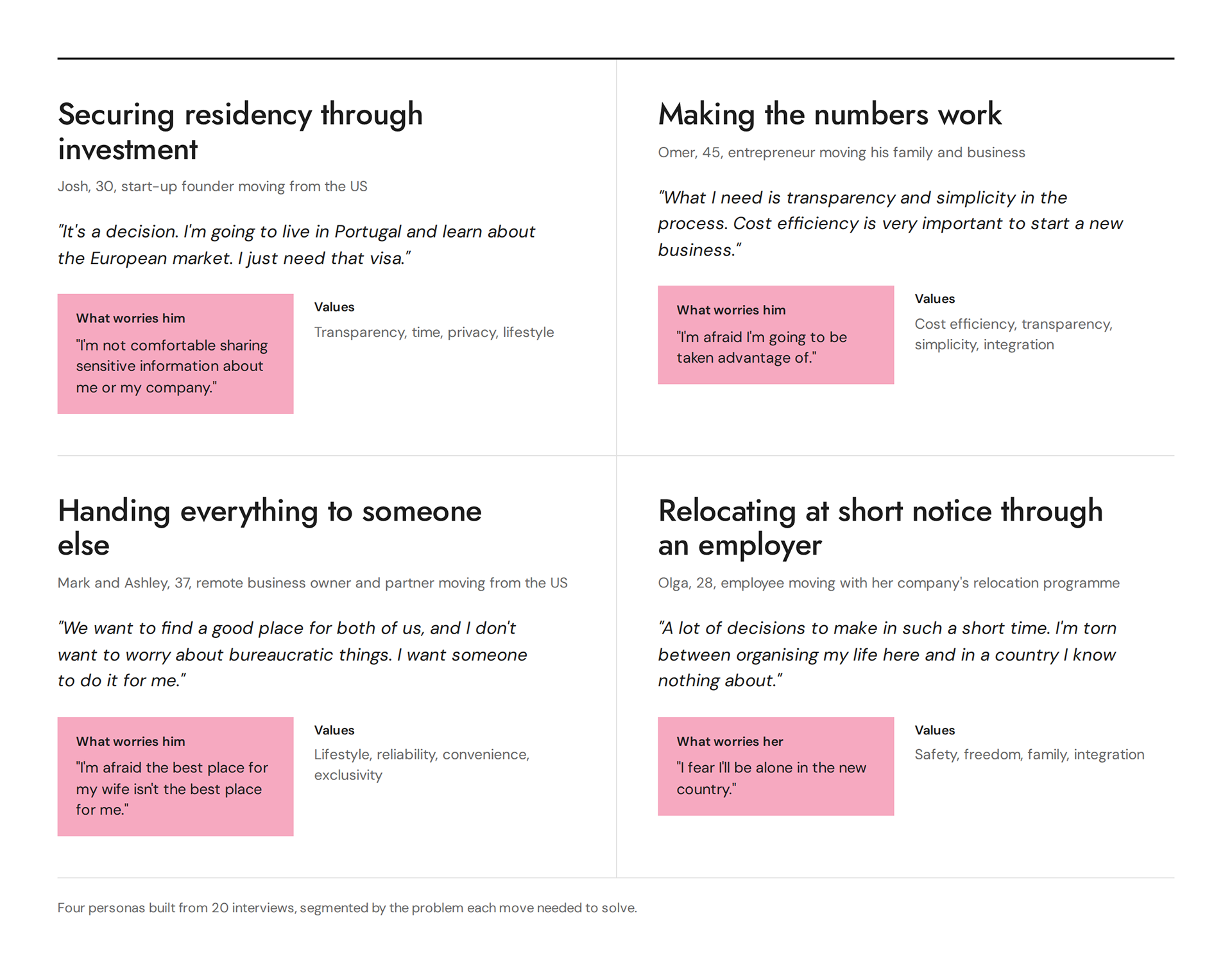
I interviewed 20 people across the relocation universe: expats who had moved or were about to, and people who help others do it. The client's own team, all expats themselves, were part of the sample.The interviews were also the basis for the personas. I didn't segment people by nationality or age, but by the patterns in their cases: the problem the move needed to solve and how much weight it carried. Four emerged: securing residency through investment, making the numbers work, handing everything to someone else, and relocating at short notice through an employer.
Alongside direct questions, I used three projective exercises to get past rehearsed answers: what kind of vehicle the company would be, what people liked to play as children and now, and how they scored their mood as an expat from 1 to 10.
The vehicle question produced one of the clearest answers in the project.

In the co-creation workshop, the client team stepped into the personas, each playing one, to write their future journeys. The ideas were then matured into MVP feature boards and prioritised by vote with the founders.
What we heard

1. Too much information, not too little
"There's the perception that everything is on the internet, but that's not exactly like that. And there's no information specifically for YOU!"
What it meant: Curate and tailor. Adding more content would make it worse.
2. Sequence matters more than completeness
"Airplane was first thought, but a plane doesn't have stops. It has to have stops on the way, like a bus or a train." Vehicle exercise
What it meant: Show the move as ordered steps, with the documents, costs and time each one needs.
3. Stress comes from losing control, not just from bureaucracy
"I can't remember who asked me what and who's doing what." On dealing with five or six people over email
What it meant: Make progress visible, and give the whole household one shared view.
4. Trust is built by people, and the first call is where it happens
"If I don't know anyone in the country, I also don't know who to trust."
What it meant: The platform should lead to a person, not replace one. The client's own team said it plainly: they had tried sending documents first, and nothing worked as well as a first call.
From insight to decision
Each finding became a design principle, and each principle a feature.

What testing changed
Ten remote moderated sessions with the interactive prototype. Three things changed.
The roadmap was too dense. Showing every stage's documents, costs and time at once recreated the overload the research had warned about. We changed it to lead with the next step and let people expand the rest when they were ready.
Costs came too late. The fear of being overcharged, which came up again and again in the interviews, came up again in testing. People wanted a sense of cost before giving their details. Price ranges per step moved ahead of sign-up.
The language was ours, not theirs. NIF, NISS and NHR meant nothing to someone who hadn't arrived yet. Every term got a plain-language label and a one-line explanation.
All three were the same lesson as the research: orientation before detail.
Outcome
The sprint ended with a tested prototype and a scoped MVP. The founders came in with a concept already formed. They left with evidence on which parts of it held up, which didn't, and what to build first, and used it to shape the business model they took forward. I don't know what was built afterwards.
What I'd do differently
Argue with the evidence on the table. Most people we interviewed had already chosen their country, and that finding was on the insights board. Destination matching still went into the MVP, and I didn't argue against it. Today I'd frame it as a decision with a cost and make the case.
Label every idea by its source. Some ideas on the boards came from users, others from the founders' existing plans, and gamification was one of the latter. I'd now tag each idea as user evidence or client hypothesis before anyone votes, so prioritisation is honest about what it rests on.
Size the findings. Twenty interviews told us what mattered, not how widely. A short survey after synthesis would have shown how far the main findings held.